
About Ion by Intuitive™
Robotic bronchoscopy for minimally invasive lung biopsies
The Ion endoluminal* system gives doctors a nonsurgical way to biopsy lung nodules. With Ion, your doctor uses your lung’s airways to travel to a lung nodule found on a chest X-ray, CT scan, or MRI.
Ion’s unique design allows your doctor to navigate the lung airways’ tiny bends and curves. From deep in your lung to its far edges, your doctor can biopsy nodules less than a centimeter wide. For reference, that’s about the size of a pea. The ability to sample small nodules throughout the lung may help doctors diagnose lung cancer at an early stage.
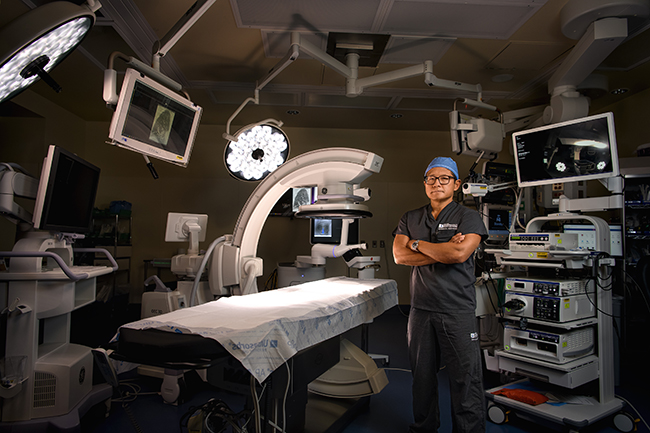
Dr. Peter Hahn, Board-Certified Pulmonologist, Critical Care & Sleep Specialist at Good Shepherd Pulmonology.
Your Biopsy Begins with a Plan
Your lungs fill with air through a complex structure of airways that get smaller as they branch out from your trachea (windpipe). Ion’s special planning software creates a detailed 3D airway map from your CT scan. The map shows possible paths to reach the nodule. Your doctor chooses a path and uploads the plan to the Ion system.
Your Ion Procedure
In conventional bronchoscope biopsies, doctors manually move thicker catheters while viewing images on a screen. With Ion, your doctor steers an ultrathin tube (catheter) to the nodule. The preplanned map provides GPS-like navigation, giving your doctor turn-by-turn directions.
Ion’s navigation system and a lighted vision probe show what’s ahead, allowing your doctor to guide the catheter to its destination. Ion also uses shape sensing, a novel technology that measures the catheter’s full shape hundreds of times per second.3 With shape sensing, Ion provides the precision and stability needed to reach and biopsy small nodules all the way out to the edges of the lungs.4
Once the catheter reaches the nodule, Ion’s flexible, steerable tip lets your doctor collect multiple samples from different angles. We call this cloud biopsy.5 Collecting multiple samples from different areas of the lung nodule helps get the best results, especially in identifying lung cancer. It may also help enable biomarker testing.
Biopsies with the Ion system require general anesthesia and are usually performed as an outpatient procedure. An outpatient procedure means you’ll go home the same day.
Talk to Your Doctor
Be sure to talk to your doctor about the outcomes they deliver using the Ion system, as every physician’s experience is different. For example, ask about:
- Complication rates
- Success of reaching small nodules in difficult-to-reach locations
- How often they get a diagnosis based on the biopsy sample
In addition, you can visit Intuitive’s What to Expect to learn about the day of your lung biopsy.